

Furnace Won’t Turn On — Common Causes & Furnace Repair in Cornwall
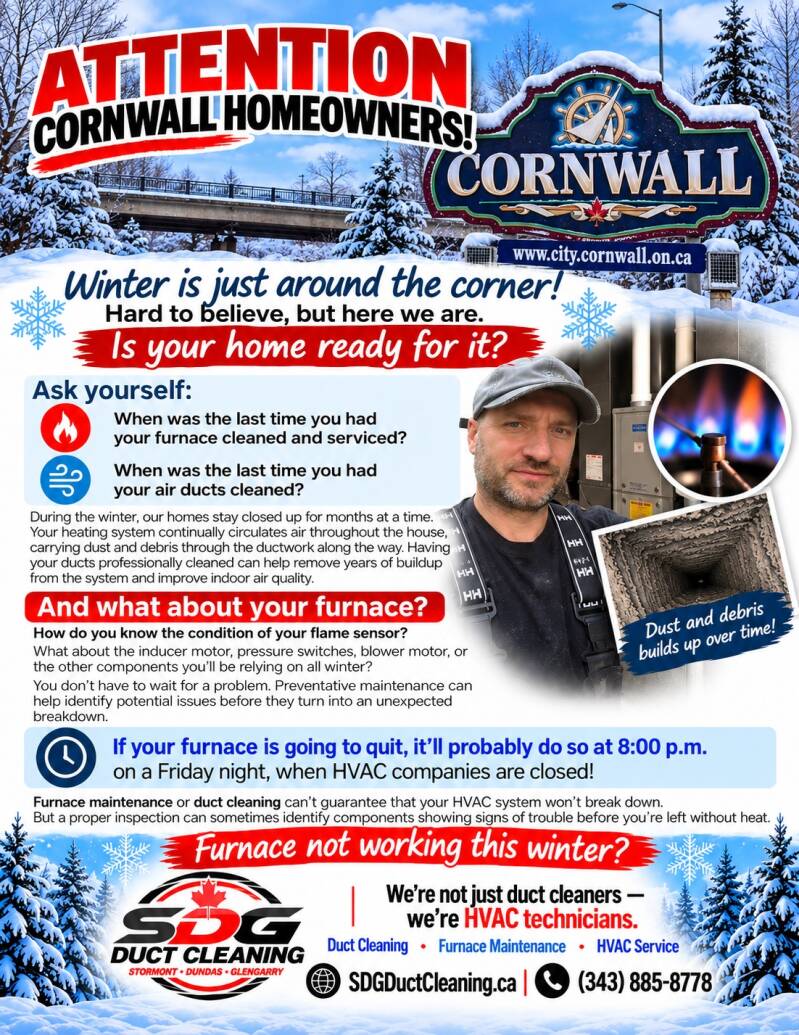
When the temperature drops in Cornwall, the last thing you want is to turn up your thermostat and discover that your furnace won’t start.
There are many reasons a furnace may not turn on. Sometimes the problem is relatively simple. Maybe the thermostat batteries are dead. Easy fix—change the batteries, turn the thermostat up, and you’re back in business.
Other times, it’s not so simple. The thermostat batteries are good, the temperature is turned up, but the furnace still won’t start. Or maybe the furnace seems to be running, but all you’re getting is cool air blowing from the registers—as if your furnace has suddenly decided it wants to become an air conditioner.
At SDG Duct Cleaning, we’ve always promoted ourselves as more than your typical duct cleaning company. While we take pride in providing professional duct cleaning services throughout Cornwall and SDG, a big part of what makes us good at what we do is our HVAC experience.
We’re HVAC technicians—not just duct cleaners. We understand the equipment connected to the ductwork, how a furnace operates, and how to troubleshoot it when something goes wrong.
That also means when one of our customers has a problem with their furnace, they can contact us for help. Whether you own a Lennox, Rheem, Keeprite, Carrier or another common furnace brand, SDG Duct Cleaning can diagnose and repair many common furnace failures.
What Happens When Your Furnace Tries to Start?
Understanding what your furnace is doing—or not doing—can provide important clues about the problem.
On a typical gas furnace, the heating sequence generally looks something like this:
- The thermostat calls for heat.
- The inducer motor starts.
- The pressure switch closes.
- The igniter heats up or begins sparking.
- The gas valve opens.
- The burners ignite.
- The flame sensor confirms that a flame is present.
- The blower motor starts and sends warm air through your home.
If something goes wrong during this sequence, the furnace may stop and display an error code.
As HVAC technicians, one of the first things we look at is where in this sequence the furnace is stopping. That can help point us toward the actual problem rather than simply replacing parts.
Common Reasons a Furnace Won’t Turn On
Thermostat or Power Problem
Before assuming something inside the furnace has failed, it's worth checking the basics.
Make sure the thermostat is set to heat and that the temperature is set above the current room temperature. You can also check whether the furnace switch or circuit breaker has accidentally been turned off.
If the furnace has power and is receiving a call for heat but still isn't starting, further diagnosis may be required.
Inducer Motor Isn't Starting
The inducer motor is normally one of the first components you'll hear after the thermostat calls for heat.
If the inducer doesn't start, the furnace usually won't be able to continue through its ignition sequence.
The problem could involve the inducer motor itself, the furnace control board, electrical connections or another part of the safety circuit.
Pressure Switch Isn't Closing
Once the inducer is running, the furnace needs to confirm that the venting system is operating properly.
The pressure switch is part of this safety system.
A pressure-switch fault doesn't automatically mean the pressure switch itself is bad. Problems with the venting, inducer, tubing, condensate drainage or other components can sometimes prevent the switch from closing properly.
That's why the cause should be diagnosed before replacing the switch.
Furnace Igniter Isn't Working
If the inducer starts but the burners never ignite, the igniter may be one of the components that needs to be checked.
A failed hot-surface igniter can prevent the furnace from lighting even though other parts of the startup sequence appear to be working normally.
Igniter Glows but the Furnace Doesn't Light
This is a particularly useful symptom.
If you can see the igniter glowing but the burners never light, the furnace has already made it through several stages of its startup sequence.
At that point, the gas valve, gas supply, furnace controls and related components may need to be tested.
Simply seeing a glowing igniter doesn't tell us exactly what's wrong, but it gives us valuable information about where the furnace is stopping.
Flame Sensor Problem
Sometimes the furnace will actually light but shut the burners off shortly afterward.
A dirty or failing flame sensor can be one possible cause.
The flame sensor is designed to prove that a flame is actually present. If the furnace control doesn't receive the proper flame signal, it will shut off the gas as a safety measure.
Blower Motor Isn't Running
Your burners may be operating normally, but you still aren't getting heat through the registers.
In that situation, the problem may be related to the blower motor, capacitor, control board or another electrical component.
Airflow problems should also be investigated because a furnace that cannot move enough air may overheat and shut itself down on its limit control.
Furnace Control Board Problems
The control board manages much of the furnace's operating sequence.
A control-board problem can cause many different symptoms, including a furnace that won't start, components that don't receive power when they're supposed to, or a furnace that stops partway through its startup sequence.
A control board shouldn't be condemned simply because the furnace isn't working. Proper electrical testing is important before replacing an expensive component.
Is Your Furnace Showing an Error Code?
Many modern furnaces have an LED on the control board that flashes a diagnostic code when something prevents the furnace from operating normally.
Don't immediately reset the furnace if you can see a code.
Take a picture or write down the flashing pattern. That information can be extremely helpful when diagnosing the problem.
The code doesn't necessarily tell you exactly which part needs to be replaced. Instead, it tells us what condition the furnace detected.
What Can You Check Yourself?
Before calling for furnace repair, there are a few simple things homeowners can safely check:
- Make sure the thermostat is set to heat.
- Increase the thermostat setting above room temperature.
- Check the furnace switch.
- Check the circuit breaker.
- Check whether the furnace filter is severely restricted.
- Look through the furnace sight glass for an error code.
If those basic checks don't solve the problem, it's generally better to diagnose the actual failure rather than repeatedly resetting the furnace or replacing parts based on guesses.
Furnace Repair in Cornwall, Ontario
If your furnace won't turn on, SDG Duct Cleaning provides furnace troubleshooting and repair in Cornwall and surrounding SDG communities.
Because we're HVAC technicians, we can work through the furnace's operating sequence, perform electrical testing and determine where the system is failing.
Whether the problem turns out to be an igniter, inducer motor, pressure-switch issue, blower motor, control board, gas valve or another component, the goal is the same: find the actual problem before recommending the repair.
Furnace Not Working?
If you're in Cornwall or the surrounding SDG area and your furnace isn't working properly, contact SDG Duct Cleaning.
Call (343) 885-8778 or contact us through sdgductcleaning.ca to request furnace service.